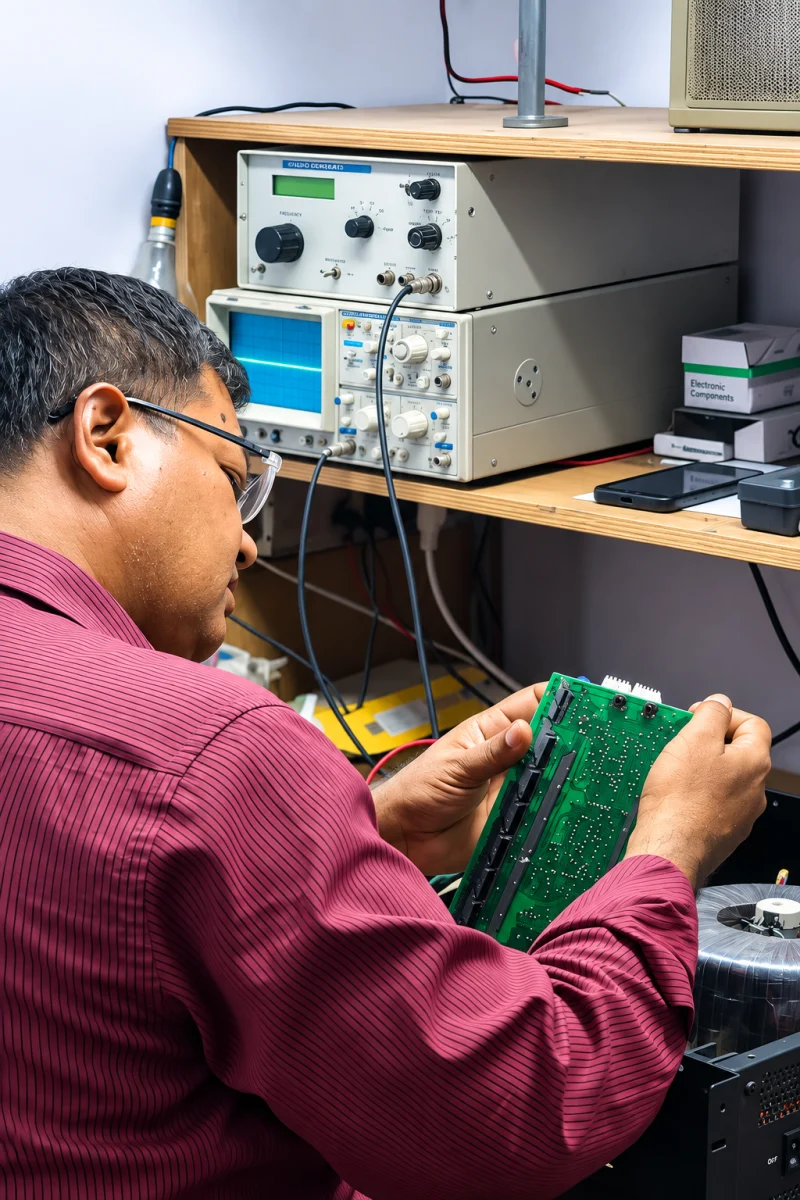
Every HYPER FIER unit is designed, wound, assembled and tested in our own Delhi facility — by people who understand the electronics, not by people reading a supplier catalogue.
Amplifier power can be quoted in more than one way, and this is worth understanding before you buy anything. Continuous RMS power is what the amplifier can sustain all evening. Peak power is what it touches for a fraction of a second. PMPO is a marketing figure with no fixed engineering definition. For the same amplifier, these three numbers can differ by three times or more.
Impedance matters just as much. The same unit will produce a very different figure into 8 ohms than into 4 ohms or 2 ohms. A wattage number written without an impedance next to it does not actually tell you anything.
We publish continuous RMS power at a stated impedance, measured under load on our own bench. When a HYPER FIER unit is sold as 4000W, that is the figure it holds — not its momentary peak.
Useful when comparing any brand: ask two questions — is that RMS or peak? and at what impedance? Any manufacturer who measures their own units will be able to answer both immediately. We publish ours on every product page.
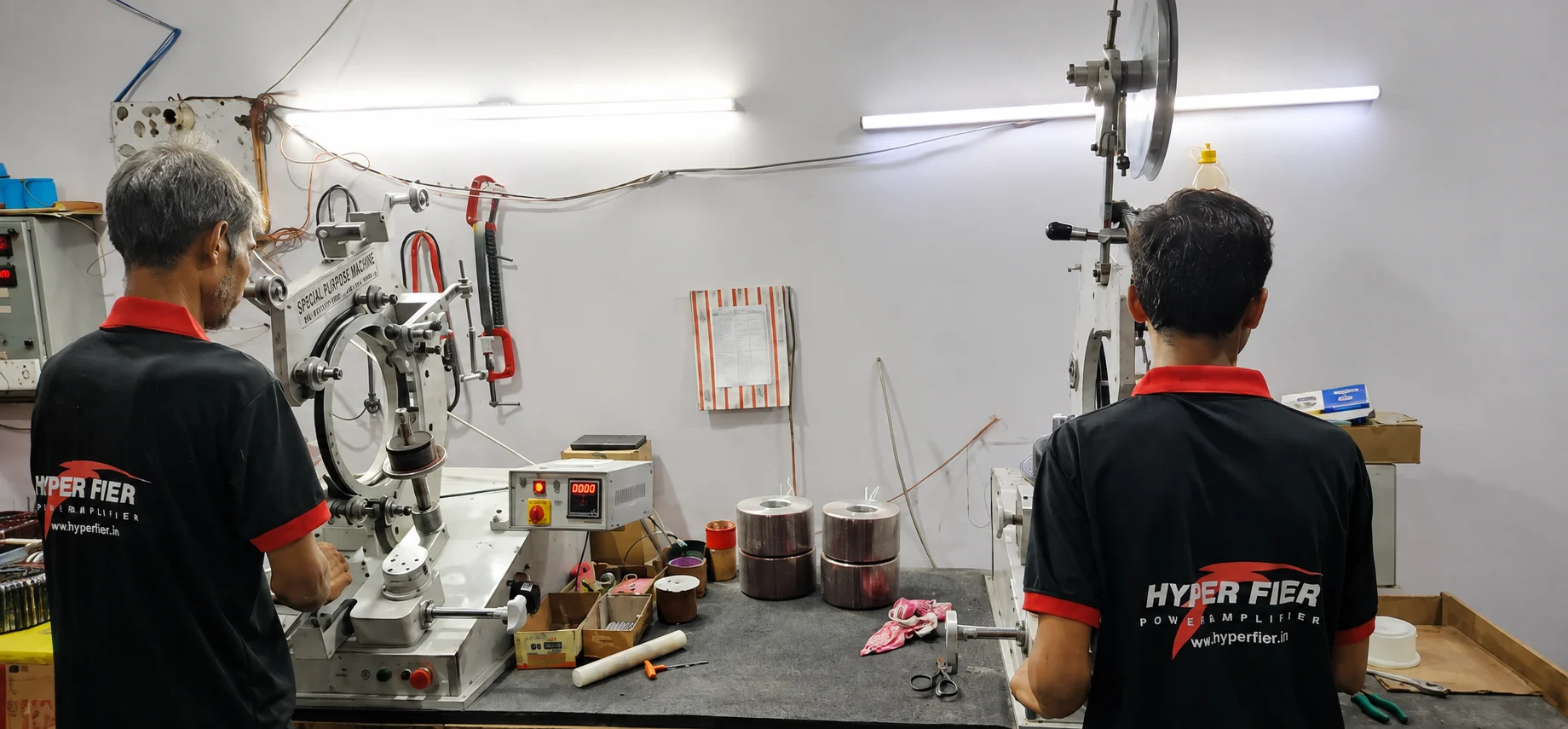
The transformer is the heart of a power amplifier. It converts mains supply into the DC rails that the output stage runs on — so when a bass note hits and the amplifier suddenly demands a large current, the transformer is what has to supply it without the voltage dropping.
This is where the winding material matters. Copper has roughly 40% lower electrical resistance than aluminium (about 1.68 vs 2.65 micro-ohm-cm). Lower resistance means less energy wasted as heat and less voltage sag under load. In practice that is the difference between bass that stays tight through a long set and bass that goes soft as the unit warms up.
Copper-clad aluminium (CCA) is a common cost-saving choice — an aluminium core with a thin copper skin. It looks like copper at the terminals, but it carries current like aluminium, and its solder joints are more prone to failure over repeated heating and cooling cycles.
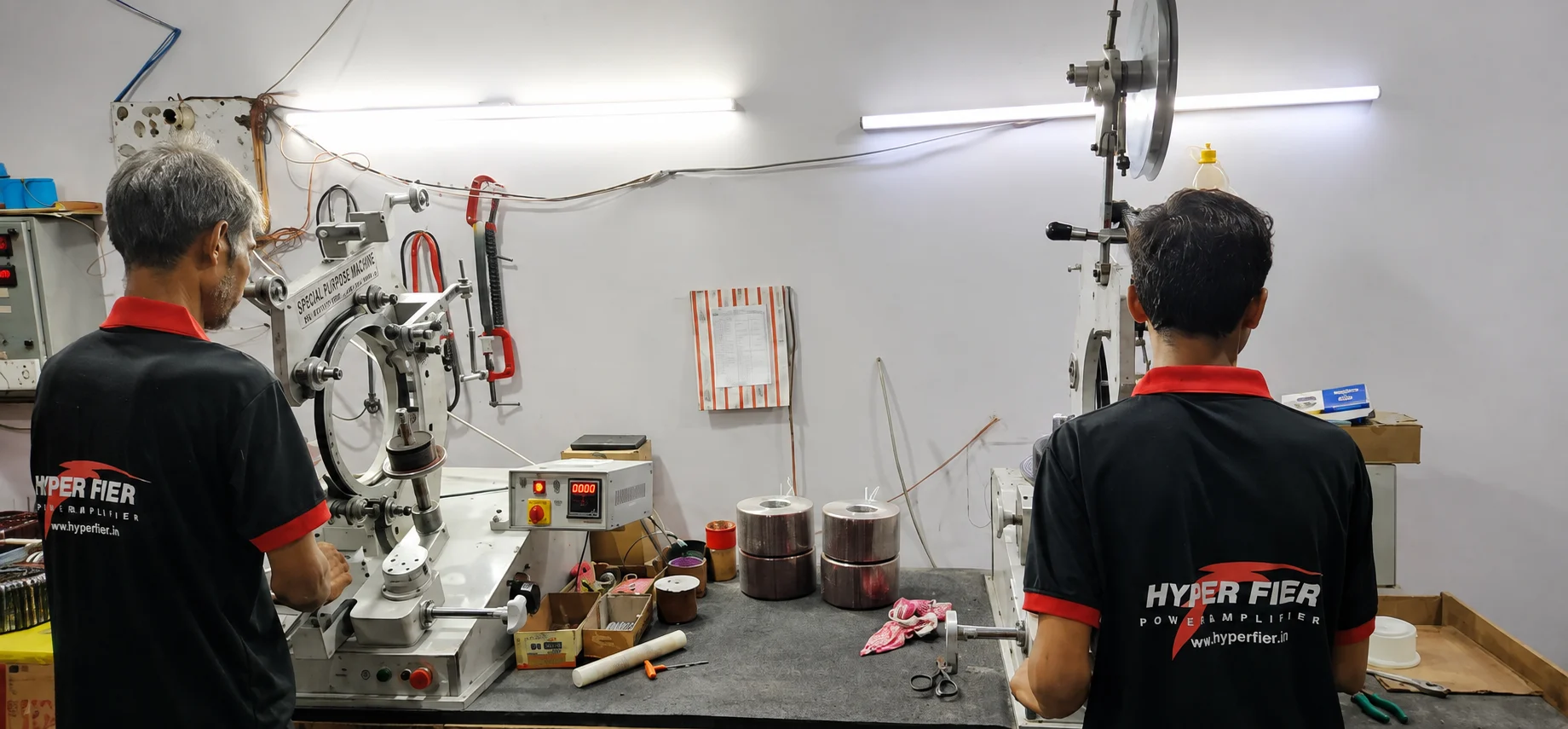
We design and wind ours in-house in 100% pure copper, choosing the gauge and turns for the actual load each model is built for. The result is better thermal headroom, stable output between 200V and 250V, and noticeably less heat over a six-hour set. It also means we hold the design, so we can service or rewind it years later.
How to check this on any amplifier: pick it up. A pure copper transformer is significantly heavier than an aluminium or CCA one of the same rating. Weight is not a perfect test, but a suspiciously light high-power amplifier is telling you something.
Output transistors do the actual work of driving your speakers. They switch large currents, they get hot, and they are the most stressed part in the amplifier. Reclaimed devices — desoldered from scrap boards and re-marked — are cheap and widely available in the market. The catch is that they usually test fine at low signal levels. The degradation shows up under sustained thermal load, which is to say: at an actual event, three hours in.
Capacitors are the other half of the story. The filter capacitors are what supply instantaneous current on a bass transient. The specification that matters is ESR — equivalent series resistance, essentially internal resistance. A high-ESR capacitor heats itself up from the inside, gradually loses capacitance, and lets the rail voltage sag. You hear that as bass going soft and mids turning harsh — and the sag then puts extra stress on the output stage.
We use original transistors from named manufacturers and low-ESR capacitors rated at 105°C throughout. It costs us more per unit. It is also the main reason an amplifier survives five wedding seasons instead of not surviving the first.
Worth asking any manufacturer: what temperature are the filter capacitors rated at, and are the output devices from a named brand? 85°C capacitors are common and cheaper; 105°C ones last considerably longer in a hot rack.
Push the master to maximum and the sound holds. No clipping, no harshness, no distortion creeping in at the exact moment the crowd peaks. Mids stay clear and vocals stay intelligible at the loudest point of the night.
The low-end is tight and controlled — the kind of punch you feel in the chest, the way a proper club system hits. But punch without mud: bass stays separated from the mids, so the track breathes instead of turning into noise.
Every amplifier runs at full load before it leaves the facility. Not a sample from the batch — every single unit. If it doesn't hold, it doesn't ship.
This is also why our service turnaround is fast: the people who repair your unit are the same people who built it, working from the same facility with the same parts in stock.
Long-term support: because we manufacture these ourselves, spare parts stay available years after purchase — not just during the warranty period.
Rental operators run equipment harder than anyone — six hours a night, loaded into a van at 2am, plugged into whatever power the venue has. That is the actual use case we design for.
Our amplifiers run cool through long sets, hold stable output from 200V to 250V, and use a thermal design that does not depend on a fan surviving. Less downtime means fewer service trips and more bookings you can actually take.
If a venue regularly runs below 200V, use a stabiliser — we will tell you that rather than claim a range we cannot back on the bench.
Every model we make has been shaped by the people who use them — mobile DJs, rental operators, event contractors and sound engineers who told us exactly what broke, what ran hot, and what they wished the panel had.
Need a specific configuration for your setup — a particular power rating, channel arrangement or panel layout? Tell us and we'll build it. A lot of what's in our current range started as one customer's request.
Most amplifier pages give you a wattage number and a photo. This page explains the machine — how mains power becomes sound, what each part does, and why the differences between amplifiers are real rather than marketing. If you understand this, you can evaluate any brand, including ours.
230V AC from the wall is stepped down by the transformer, then converted to direct current by a rectifier.
Large capacitors smooth that DC and hold a reservoir of energy, ready for the moment the music demands it.
The output devices act as fast valves, releasing that stored energy in the exact shape of the audio waveform.
Heavy conductors carry tens of amps to the speaker — and pull the cone back under control after each hit.
Your wall gives AC. A speaker needs DC. Three parts do the conversion — transformer, rectifier, capacitors — and everything after that runs on what they produce.
Mains power swings positive to negative fifty times a second. A speaker cannot use that. So step one is always the same: turn it into steady DC.
The transformer brings the voltage down. It also keeps you electrically separated from the mains, which matters as much for safety as for sound.
The rectifier is four diodes — think of them as one-way valves. They flip the negative half of every cycle up to positive. The output is now all positive, but still pulsing a hundred times a second. That pulsing is called ripple, and you would hear it as a hum.
The result is a pair of DC rails — one positive, one negative — and everything the amplifier does afterwards is drawn from them. Everything that follows in this page is about one question: how well do those rails hold up when the music gets loud?
Those big cans are not a filter. They are a fuel tank — and on a bass hit, they are the only thing feeding the amplifier.
Capacitors do smooth the ripple. But that is the side job. The real job is storage.
The rectifier refills them only a hundred times a second, in short bursts. In between those bursts, the capacitors alone are running the amplifier.
A kick drum lasts a fraction of a second and can demand many times the average current. There is no time to fetch that from the mains. It has to already be sitting in the tank.
This is where ESR — equivalent series resistance comes in. It is the capacitor's own internal resistance. A capacitor with high ESR cannot release its charge quickly, so when the output stage suddenly asks for a large current, the rail voltage dips instead. That dip is called rail sag, and you hear it as bass losing weight the louder you push.
High ESR causes a second problem: the capacitor heats itself from the inside as current passes through that internal resistance. Heat is what kills electrolytic capacitors — the electrolyte dries out, capacitance falls, ESR climbs further, and the process accelerates. That is why the temperature rating matters. An 85°C capacitor is common and cheaper. We use 105°C low-ESR parts, which is a meaningful difference inside a hot rack on a summer night in a closed hall.
What this means in the field: if an amplifier sounds strong for the first hour and gradually goes soft in the bass, that is almost always the power supply — capacitors heating and rails sagging — not the speakers and not the mix.
An amplifier never makes your signal bigger. It uses your signal as a tap handle, and the power comes from the wall.
This one idea makes everything else click, and almost nobody explains it.
The small signal from your mixer is not magnified. It controls a tap — deciding, moment by moment, how much of the already-large rail voltage reaches your speaker.
The transistors are that tap. A tiny current at the base lets a much larger current flow through the device. In practice it behaves like a resistance you can change electronically, thousands of times a second, instantly.
So the output stage is a pair of fast valves sitting between the DC rails and your speaker: one handling the upward half of the waveform, one handling the downward half, opening and closing in the exact pattern of the music. Get the handover between those two halves wrong and you introduce distortion — which is precisely what separates the amplifier classes below.
Now you can see why the transistor's own quality is not a detail. These devices switch large currents and dissipate real heat as they do it, because a partially-open valve turns the difference into warmth. Reclaimed transistors — recovered from scrap boards and re-marked — will usually test correctly at low signal levels. Their weakness is thermal: the degraded die cannot handle sustained heat, so the failure shows up under load, at an event, hours in. That is the worst possible time and place to find out.
Thin wire does not just waste power. It stops the amplifier from controlling your woofer — and that is what you hear as loose, boomy bass.
These are not small currents. A 2000W amplifier into 4 ohms pushes over twenty amps at peak. Every conductor it passes through has resistance — windings, internal wiring, terminals, your speaker cable — and resistance does two things: makes heat, and drops voltage.
The heat is the obvious cost. The voltage drop is the expensive one, and it is why copper matters: copper has roughly 40% lower resistance than aluminium (about 1.68 versus 2.65 micro-ohm-centimetres). Same design, same everything else — an aluminium or copper-clad-aluminium winding simply gives up more voltage as heat under load.
But there is a second effect that most buyers have never heard of, and it is the one you can actually hear. It is called damping factor.
A speaker cone has mass. When the amplifier drives it forward and then stops, the cone wants to keep moving — and as it does, the voice coil moves in the magnet and generates a current of its own, flowing back into the amplifier. A low-resistance path back to the amplifier lets that current dissipate, which brakes the cone. A high-resistance path does not.
Damping factor is simply the speaker's impedance divided by everything resisting that return path — the amplifier's output impedance plus the wiring plus your speaker cable. A high damping factor means the amplifier grips the cone and stops it on command. A low one means the cone carries on wobbling after the note has finished. That is the difference between bass you feel as a distinct hit and bass that arrives as a boom which smears into the next one.
Worth knowing: this is also why thin speaker cable ruins good amplifiers. You can add more resistance in a long run of cheap cable than exists in the entire output stage. For long runs, thicker cable is not an upgrade — it is damage control.
Class is not a quality ranking. It only describes how much of the wave the transistors stay switched on for — and each choice trades one thing for another.
That single choice sets efficiency, heat, distortion and cost. A later letter does not mean a better amplifier.
| Class | How it works | Typical efficiency | The trade-off |
|---|---|---|---|
| Class A | Transistors conduct through the entire cycle, always fully on. | 20–30% | Cleanest handover, but most of the power becomes heat. Impractical above modest wattage — you would need an enormous heatsink for a PA amplifier. |
| Class B | Each transistor conducts for exactly half the cycle. | up to ~78% | Efficient, but both devices are momentarily off as the signal crosses zero. That gap produces crossover distortion, which is most audible at low volume. |
| Class AB | Slightly more than half each — a small bias current keeps both devices just barely conducting through the crossover point. | 50–70% | Removes crossover distortion for a small efficiency cost. Excellent sound, handles difficult loads down to 2 ohms, tolerant of unstable supply, and repairable by any technician. The professional standard for decades, and still the right choice up to around 4000W. |
| Class H | A Class AB output stage fed by two or more rail voltages. It runs on the low rail normally and switches to the high rail only when the signal peaks. | 70–85% | Far less waste heat, so much bigger peaks from the same transformer and heatsink. The cost is complexity: rail switching must be seamless, there is more protection circuitry to trip, and field repair is harder. Worth it on large systems, unnecessary below them. |
| Class D | Not analogue at all. The output devices switch fully on and fully off at high frequency, and a filter reconstructs the waveform from the pulse widths. | 90%+ | Very efficient and very light. Depends heavily on output filter and switching design quality, and is significantly harder to repair in the field. The "D" stands for nothing — it is simply the next letter. |
| Class TD | A hybrid approach using Class D-style rail tracking with an analogue output stage. | ~85% | Worth knowing because you will see the term quoted. It is a trademarked designation belonging to a specific manufacturer, not an open industry class like AB or H. |
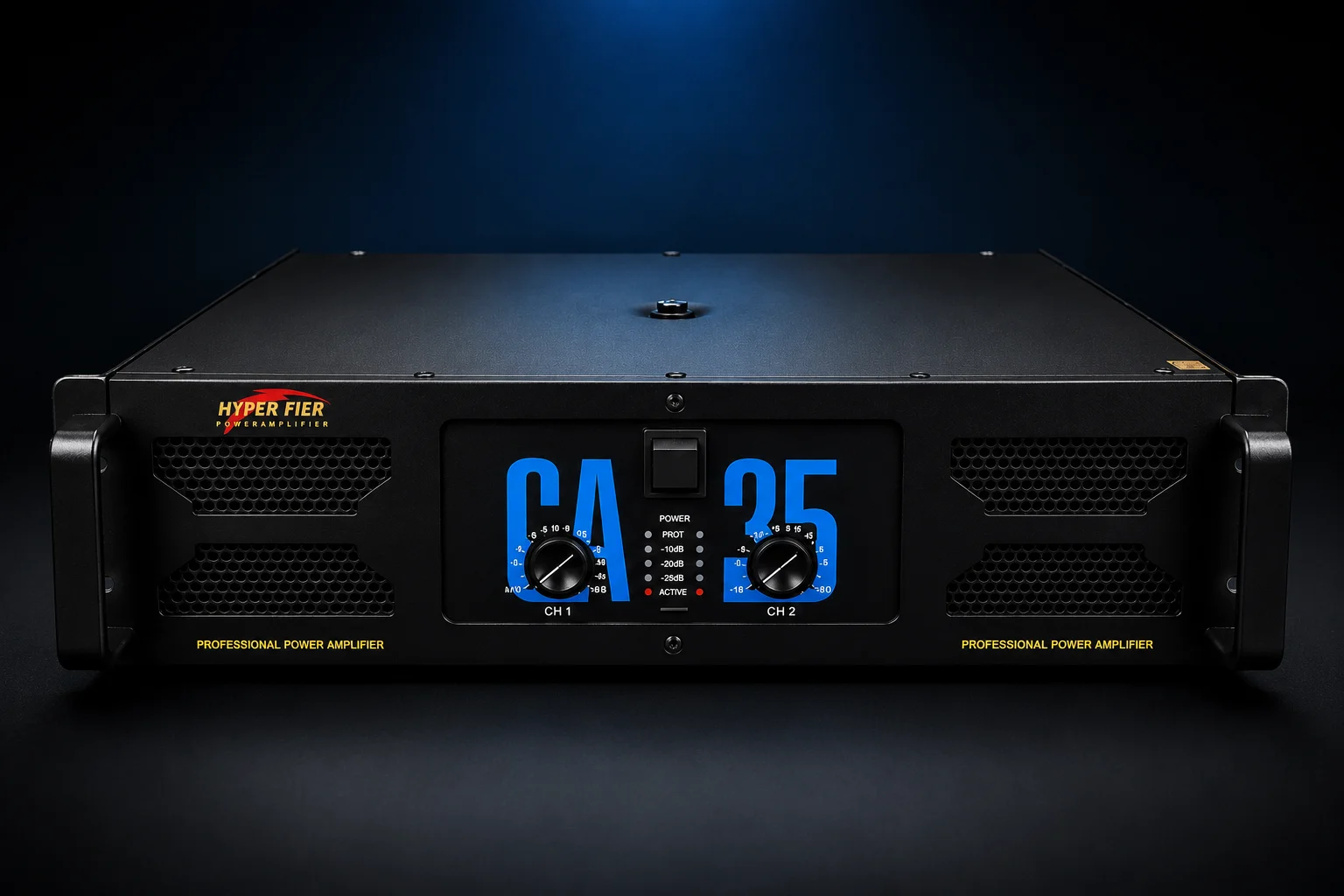
HYPER FIER builds Class AB and Class H — and we choose between them by the job, not by what sounds more impressive. Class AB across HF, DJ and DJX. Class H in CA and VTX/MT, where output has to be sustained for hours.
Class H is not an upgrade. Below about 4000W, Class AB usually gives you the better amplifier — better sound, tougher under load, and repairable anywhere in India.
There is a habit in this market of treating a later letter as a better product. It is worth saying plainly: Class H is not a superior version of Class AB. It is a solution to a specific problem — heat at very high power — and it costs you something to get there.
Here is what Class AB gives you that you should not give up lightly.
Nothing switches. The output stage sits between two steady rails and does one job. There is no rail changeover to get right, and nothing that can leave a mark on the waveform when it happens. At sensible power levels this is simply the most transparent way to build an amplifier — which is why studio and installation work still runs on it.
Four ohms, two ohms, a stack of speakers in parallel on a chaotic wedding stage — a properly built Class AB output stage keeps working. There is real current reserve in the design rather than a circuit sitting close to its limit. This is the difference between an amplifier you have to be careful with and one you can just use.
More complexity means more protection circuitry, and more protection circuitry means more ways to cut out mid-set. Class AB is a simple, tolerant design. When the load is difficult and the supply is unstable, simple is exactly what you want.
This is the one most buyers underestimate. A Class AB output stage is understood by every competent audio technician in the country, and its parts are available in any electronics market. Three years from now, in a town far from Delhi, that matters far more than a few percent of efficiency.
The one real cost of Class AB is heat, and heat scales with power. At 1200W, 2000W, 3000W, even 4000W, that cost is entirely manageable with a properly sized transformer and heatsink — which is exactly how we build the HF, DJ and DJX ranges. You get every advantage above and pay very little for it.
It is above that, and on jobs that run at high output for hours without a break, that the heat becomes the limiting factor rather than an inconvenience. That is where Class H earns its place — and that is why our CA and VTX/MT ranges use it.
Put simply: choose Class AB for sound quality, load tolerance and easy service. Choose Class H when the job is genuinely big — large stages, line arrays, long-duration high output. Anyone selling you Class H for a 2000W wedding rig is selling you a letter, not an advantage.
Class H does not sound different. It has more room left for the peak — and a kick drum is a peak.
Anyone who has run both will say Class H feels like it punches harder. True — but not for the reason most people assume. It is not tone. It is headroom, and it comes from how music is shaped.
Music is not one flat level. It is mostly moderate with brief violent spikes — a kick, a snare, the first beat after a drop. That gap between peak and average is crest factor, usually 10 to 20 dB. At 10 dB, the peaks want ten times the power of the average.
So a single-rail amplifier has to sit ready for those peaks all night, even though most of the night is nowhere near them. Everything between the rail and what the music actually needs turns into heat.
Class H solves this by keeping more than one rail voltage available. At normal levels it runs from a lower rail, so the gap being wasted as heat is much smaller. When a transient arrives, it switches to the high rail for the fraction of a second that peak lasts, then drops back.
The result: for the same transformer, the same heatsink and roughly the same cost, a Class H design can deliver considerably larger short-term peaks. And short-term peaks are exactly what a kick drum is. The amplifier is not compressing the transient because it ran out of headroom — so the hit lands intact. That is the punch.
The honest version: at the same continuous power into the same speakers, a well-built Class AB and a well-built Class H will sound very similar. Class H does not have a different tone. What it has is more room for the peaks before it runs out — which is why it belongs on long events and large systems, and why Class AB remains the sensible choice everywhere else.
Every point on this page is something you can verify for yourself, on any brand, including this one.
1. Is that RMS or peak, and at what impedance? A wattage figure without an impedance beside it is not a specification. Any manufacturer who measures their own units answers this immediately.
2. Pick the amplifier up. Transformer and heatsink are the heaviest parts, and neither can be faked. A high-power amplifier that feels light is telling you where the cost was saved.
3. Ask what the filter capacitors are rated at. 85°C or 105°C. Ask what the total capacitance is. A brand that knows their own build will know the numbers.
4. Ask where it gets serviced, and by whom. A manufacturer services its own designs and stocks its own parts. An importer sends the unit away and hopes.
5. Ask what happens at 190 volts. Any amplifier works at a clean 230V. What matters is what it does when the supply falls, which in most of India it will.
Our answers: continuous RMS at stated impedance, published on every product page — in-house wound 100% pure copper transformers — 105°C low-ESR capacitors — original transistors from named manufacturers — stable output from 200V to 250V — serviced by the people who built it, in Delhi, with parts in stock beyond the warranty period.
I've been building amplifiers in Delhi since 2009. For the first ten years we manufactured for other brands — which meant I saw exactly how the industry cuts corners, and where every failure comes from.
In 2019 we launched HYPER FIER under our own name. The idea was simple: build the amplifier I'd want to buy myself. Rate it honestly. Use real components. Stand behind it when something goes wrong.
Every circuit decision here is made by someone who understands the electronics — not by someone selecting parts from a supplier catalogue to hit a price.
Started building professional amplifiers in Delhi, manufacturing for established audio brands and learning where every design fails in the field.
Launched under our own name with a simple rule: honest wattage, in-house transformers, original components. No claims we can't measure.
Selling direct from the factory to DJs, rental businesses and event contractors across India — with the service backing that only a manufacturer can give.
Browse the range, or tell us your setup on WhatsApp and we'll recommend the right amplifier — there's no benefit to us in overselling you a bigger unit than you need.
Leave your number and we'll send new models, offers and dealer pricing before anyone else.
